Getting the Hardware Right
We're not interested in doing things the cheapest way. We do things the right way, and that starts with matching hardware to what the job actually demands over its full lifecycle, not just what keeps the upfront cost down.
There's nothing wrong with using affordable equipment like Ubiquiti. We use it regularly and rate it highly for the right applications. But its limitations and expected lifespan need to be understood by everyone involved before it goes up on a mast. For links that carry critical traffic or need to hold up for a decade in harsh conditions, the hardware choice looks different, and the total cost of ownership usually favours spending more upfront.
Your team has the IT skills to run the network. Let us pour the concrete, weld the steel, climb the towers, run the fibre, and wire the power.
Licensed & Unlicensed Microwave
When a link needs to deliver serious throughput or guaranteed reliability, microwave is the way to go. We install both unlicensed and licensed microwave systems operating from 6 to 80 GHz, with data rates from 100 Mbps to over 2 Gbps.
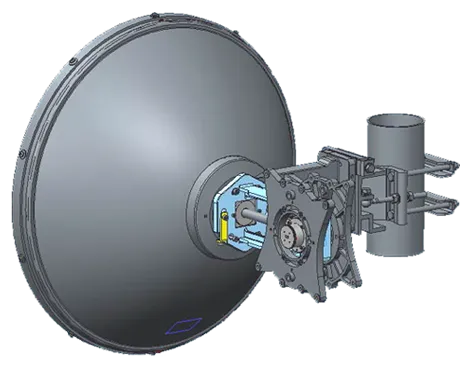
Range varies with the application. On the short end, suppliers like Siklu provide high-performance links as close as 10 metres, ideal for building-to-building connections in dense environments. On the long end, brands like Cambium deliver reliable links out to 100 km for remote backhaul and inter-site connectivity. Cost generally scales with distance, so we design to what the link actually needs rather than overbuilding.
Unlicensed spectrum works well for many deployments, but for links where interference can't be tolerated or where you need guaranteed channel availability, a licensed microwave link with a registered frequency allocation is the right call.
Link Design & Simulation
Before anything gets installed, we model it. Through our partnership with Axidra, we have access to an advanced digital twin of Australia that maps high-resolution terrain, tree canopy, and buildings. The platform uses a raytracing physics engine that lets us simulate link performance at frequencies up to 100 GHz, accounting for obstructions, reflections, and diffraction along the actual path.
What that means in practice: we can tell you whether a proposed link will work, what performance to expect, and where problems might occur, before a single bracket goes on a wall. For complex deployments with multiple links or challenging terrain, this takes the guesswork out of the design and avoids expensive surprises during installation.
Steel Work & Mounting
This is the part most people don't think about until it causes problems. Antenna mounting directly affects link performance. Modern modulation schemes are highly sensitive to deflection. Even slight movement in a mast, caused by wind loading or vibration, can cause rapid changes in data rate and dropped packets. If you're operating under an SLA, that matters.
Off-the-shelf mounts from generic suppliers are generally not engineered for the weight, surface area, and wind loading of the antennas used in serious communications infrastructure. A bracket that works fine for a home TV antenna is a different proposition when it's holding a 1.2 metre microwave dish 40 metres up.
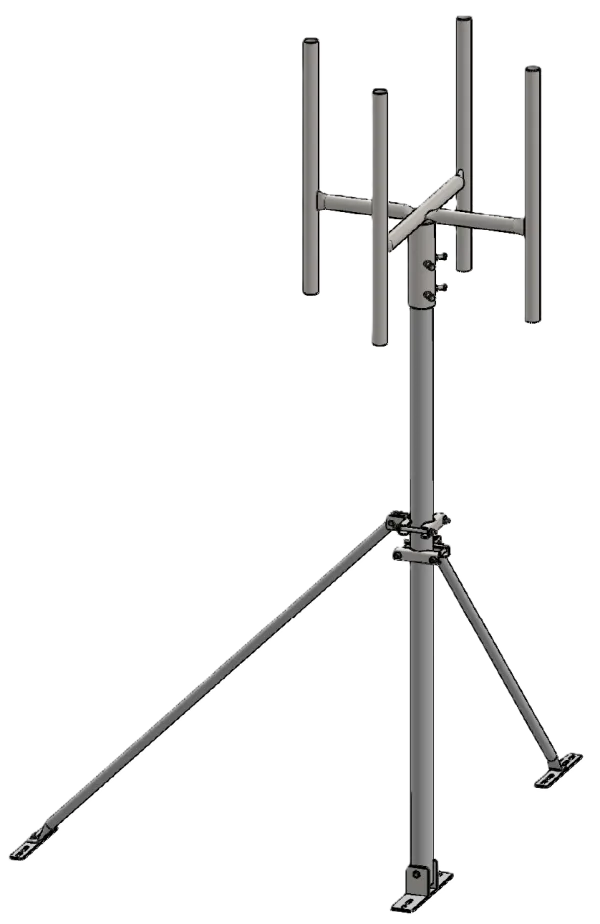
We commission custom fabricated and engineered steel work designed for the specific hardware and conditions of each job. For larger builds, we manage tower and mast projects from design through construction, working with specialist engineering and fabrication partners to deliver the structure, then handling the communications fit-out ourselves.